

 Share


DJI agricultural drones fly off to Southeast Asia
Editor: Zhang Chanwen | Updated: 2026-10-27
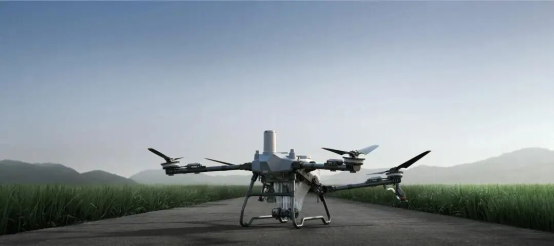
On May 20, AGRITECHNICA ASIA 2026 opened in Bangkok, Thailand. A premier agricultural trade fair organized by DLG, the German Agricultural Society, this year's event attracted enterprises from the global agricultural machinery and smart agriculture sectors.
Shenzhen-based DJI Agriculture, a leading Chinese agricultural technology company, officially launched the overseas version of the DJI agricultural drone T55 and the T100 dual-battery spraying system for the Thai market.
The "Agricultural Drone Industry White Paper (2025/2026)" released by DJI and Farmers' Daily in July disclosed that by the end of 2025, over 600,000 units of DJI agricultural drones had been deployed in more than 100 countries and regions worldwide. Working with precision and efficiency, the drones have cumulatively saved 410 million tons of water globally and reduced carbon emissions by 51 million tons.
It is reported that DJI continues to push the application of agricultural drones into more scenarios such as transportation and orchard management.
In Southeast Asia, utility poles, power lines, and other obstacles are densely distributed and have always been a safety hazard in drone operations. During rainy-season operations, rain and fog further reduce visibility, multiplying the difficulty of obstacle avoidance.
To address these pain points, the overseas version of the T55 upgraded its safety perception capabilities, enabling more accurate identification of obstacles and achieving stable obstacle avoidance even in complex weather conditions. The system can also "remember" identified obstacles and continuously optimize obstacle avoidance performance in subsequent operations. An upgraded software system combined with a low-light full-color camera allows operators to see the surrounding environment of the drone even at dusk or on overcast and rainy days.
The overseas version of the T55 also allows a payload of up to 40 kilograms, so that the drone can spray pesticides, spread fertilizers, or transport agricultural supplies.
Catering to the needs of large orchards, DJI's T100, equipped with a dual-battery spraying system, increases hover time by 50% when fully loaded with 90 liters of pesticide. Farmers do not need to land the drones to change batteries frequently. More importantly, the atomizing nozzle kit, through higher flow rate and finer atomization, enhances penetration into dense tree canopies and covers the undersides of leaves on tall fruit trees with dense branches and foliage. This means farmers can complete operations that previously required multiple supplemental sprayings with less time and lower energy consumption.
Thailand is one of DJI Agriculture's important markets in Southeast Asia. Zhang Yuan, sales head of DJI Agriculture, said: "Over the past seven years and more, DJI Agriculture has continued to use drone technology to promote the development of precision agriculture in Thailand. Since entering the Thai market in 2019, DJI Agriculture has trained more than 19,000 certified drone operators locally.
"To meet the growing demand for agricultural drones, DJI Agriculture has set up more than 300 stores in more than 70 Thai provinces, covering major agricultural production areas. As of December 2025, sales in the Thai market accounted for 50% of DJI Agriculture's total sales in Southeast Asia."
DJI Agriculture has previously introduced heavy-load models such as the T100 and T70P into the Thai market.It is an epitome of Chinese tech companies going global through product innovation, local services, and ecosystem building.